If you have suffered an injury or believe you have received negligent medical treatment, you may wonder whether you have a legal claim. Many people assume that if something has gone wrong, compensation will automatically follow; but in reality, there are certain legal requirements that must be proven before a successful claim can be made.
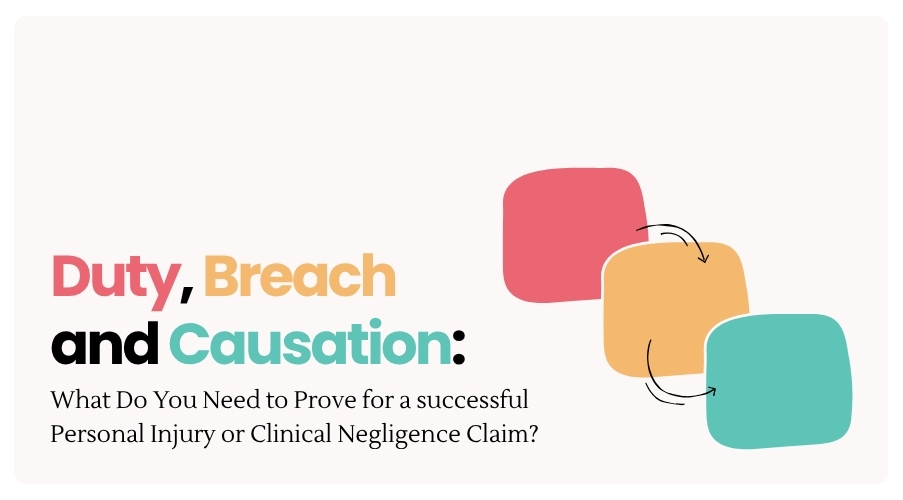
Whether the claim relates to a road traffic accident, an accident at work, or medical treatment, there are three key legal elements that usually need to be established:
- A duty of care
- A breach of that duty
- Causation
This article explains these concepts in more detail below.
What Is a Duty of Care?
A duty of care is a legal obligation to take reasonable care to avoid causing harm to another person.
In everyday life, many individuals and organisations owe duties of care to others. For example:
- Drivers owe a duty to other road users to drive safely.
- Employers owe duties to employees to provide a safe working environment.
- Doctors, dentists, nurses and hospitals owe duties to patients to provide treatment to a reasonable professional standard.
In most personal injury and clinical negligence claims, establishing that a duty of care existed is relatively straightforward.
What Is a Breach of Duty?
A breach of duty occurs when someone fails to meet the standard of care expected of them. The law does not expect perfection. Instead, it considers whether the person acted reasonably in the circumstances.
Examples of a potential breach of duty may include:
- A driver using their phone whilst driving and causing a collision.
- An employer failing to repair dangerous equipment.
- A doctor failing to investigate clear symptoms or misdiagnosing a condition.
- A doctor making an avoidable error during treatment or surgery.
In clinical negligence claims, breach of duty is often determined through independent expert evidence. The Court will usually consider whether the treatment provided fell below the standard expected of a reasonably competent medical professional in that field.
What Is Causation?
Causation is often the most important and most disputed part of a claim. Even if there has clearly been a mistake, you must still prove that the mistake actually caused the injury or worsened the outcome. In simple terms, the court asks:
“Would the injury or damage have happened anyway, even if the negligence had not occurred?”
For example:
If a driver runs a red light and causes a collision which results in a broken arm, causation may be relatively straightforward.
However, in medical negligence cases, causation can be far more complex. A patient may already have been unwell, and the question becomes whether earlier treatment would realistically have changed the outcome.
This is why medical expert evidence is often crucial in clinical negligence claims.
Are There Time Limits?
Yes. Strict limitation periods apply to both personal injury and clinical negligence claims. In most cases, Court proceedings must be issued within three years of:
- The date of the accident or negligent treatment; or
- The date you became aware that negligence may have caused your injury.
There are some exceptions to the standard three-year limitation period. For example, for children, the three-year period does not begin until their 18th birthday. For individuals who lack mental capacity, the limitation period is generally suspended unless and until they regain capacity.
If court proceedings are not issued within the relevant limitation period, you may become statute-barred from bringing a claim for compensation.
What Compensation Can Be Claimed?
If a claim is successful, compensation is generally divided into two categories: general damages and special damages.
General damages compensate you for the pain, suffering and loss of amenity caused by the injury. Loss of amenity refers to the impact the injury has had on your ability to enjoy day-to-day activities, hobbies and aspects of life that you previously enjoyed.
Special damages compensate you for financial losses and expenses arising from the injury. These may include loss of earnings, medical treatment costs, prescription charges, travel expenses, care and assistance provided by family members or professionals and future financial losses where the effects of the injury are ongoing.
It is therefore important to keep records of any expenses or losses you incur, as these may form part of your claim.
Why Early Legal Advice Matters
Negligence claims can be complex, particularly where medical treatment is involved. Early legal advice can help preserve evidence, identify whether expert evidence is needed, and ensure important deadlines are not missed.
Our Personal Injury and Clinical Negligence solicitor, Isabel Price, regularly advises clients in relation to personal injury and clinical negligence claims, including claims involving delayed diagnosis, surgical errors, accidents at work, and slips and trips on public highways.
If you would like to discuss a potential claim, please contact us.